
-

Antoine Compagnon
1 minuteWe are pleased to invite you to our second public event of 2016, organized in partnership with the French Cultural Institute and the Technical University of Cluj-Napoca!The event will consist of a series of lectures to be delivered by the reputed Professor Antoine Compagnon next Wednesday, on the 24th of February, 2016. En avant-première du…
-
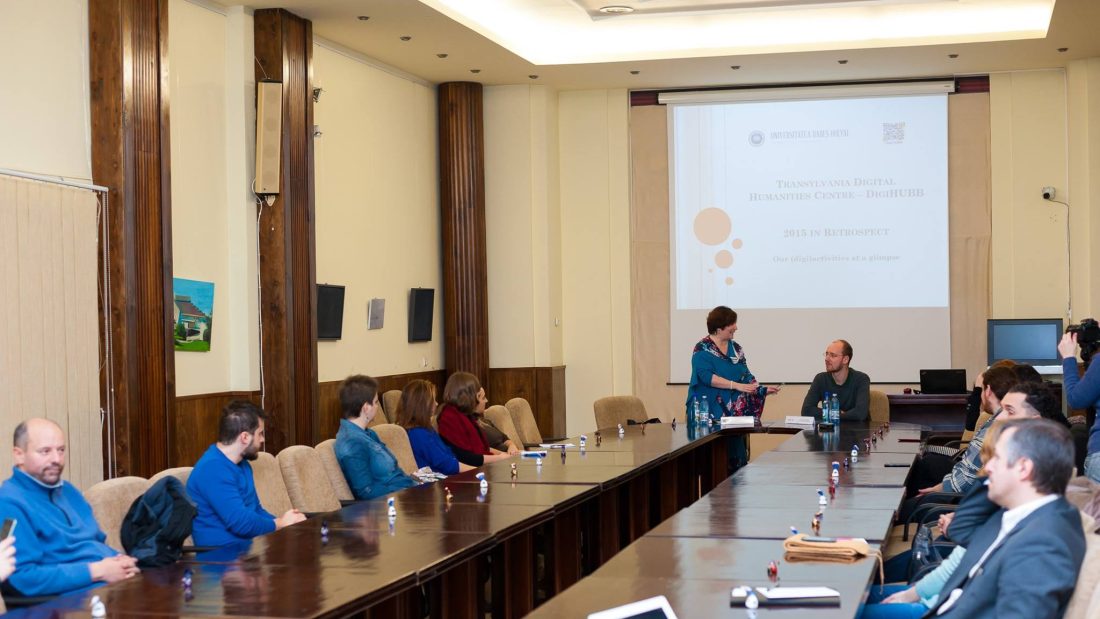
Christian Schwaderer
1 minuteDigiHUBB is pleased to invite you to its first public lecture of 2016, delivered by our guest, Dr. Christian Schwaderer from the Eberhard-Karls-Universität Tübingen, Germany. His first lecture delivered in Cluj-Napoca, titled “The Long Way to a Scholarly Edition. Technical Skills Necessary and Ways to Deal With Data Complexity”, will take place on Wednesday, the…
-
EpiDoc and Digital Classics Workshop
1 minuteStart: 27 Mar 2016End: 01 Apr 2016Location: Babeș-Bolyai University of Cluj Napoca, Romania EpiDoc and Digital Classics Workshop Babeș-Bolyai University of Cluj Napoca, Romania March 27 – April 1, 2016 The Babeș-Bolyai University of Cluj-Napoca is offering a week-long training workshop on digital encoding of inscriptions and other ancient texts, taught by Gabriel Bodard, Simona…
-
Johann Stan
1 minuteDigiHUBB invites you to the public lecture: How to be an inventor? “Innovation is a key ingredient for economic growth. It translates inventions or ideas into services that create value and generate growth. An inventor himself and now a patent examiner, Johann Stan will investigate in this talk different types of innovation (disruptive, sustainable, etc.)…
-
Julianne Nyhan
1 minuteDigiHUBB invites you to the conference An introduction to the histories of Digital Humanities, by Julianne NYHAN, Assistant Professor in Digital Information Studies at UCL’s Department of Information Studies, London, UKApril 21, 2015, 4 pm, Popovici HallBabeș-Bolyai University, Faculty of Letters, Str. Horea nr.31
-
Susan Schreibman
1 minuteDigital technologies have opened up new possibilities for humanities research: from reading a million books to reconstructing ancient sites. These technologies necessitate humanists learning new skills, that in turn, provide new methods for analysing the historical record: from non-invasive techniques to read the text on ancient scrolls so badly damaged by fire that to unroll…
Author: digihubb
